
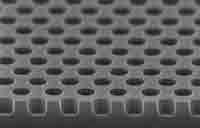
I am wondering if UniversityWafer is selling or producing silicon wafers with microwell arrays. We need silicon wafer pieces with spherical wells approximately 1µm in diameter for creating free-standing 2D materials and measuring their mechanical properties. The depth of the wells could be 100-200nm and we would initially require five wafers.
Substrates for 2D Material Research
2D materials such as graphene, MoS₂, WS₂, WSe₂, h-BN, and MXenes are widely studied for next-generation electronics, photonics, sensors, quantum devices, and energy applications. Successful growth, transfer, exfoliation, and characterization of these materials requires carefully selected substrates including SiO₂ on silicon wafers, sapphire substrates, quartz, fused silica, graphene wafers, and HOPG.
Microwell Arrays for Free-Standing 2D Materials
Researchers studying the mechanical properties of atomically thin materials often require custom silicon wafers with micron-scale structures. One assistant professor requested the following:
Reference #260344 for specifications and pricing.
Get Your 2D Materials Research Quote FAST! Or, Buy Online and start researching today.
Sapphire Substrates for 2D Material Growth
Sapphire wafers are among the most popular substrates for CVD growth of graphene and transition metal dichalcogenides. Their thermal stability, surface quality, and optical transparency make them ideal for 2D materials research.
A doctoral student researching nanobioelectronics requested double-side polished sapphire substrates measuring 25mm × 25mm × 0.5mm for growth of two-dimensional materials and biosensor applications.
Reference #278810 for specifications and pricing.
C-Plane Sapphire for 2D Materials and Epitaxy
A PhD candidate requested custom C-plane (0001) sapphire substrates with a 0.2° miscut toward the A-axis for 2D material growth and advanced semiconductor research.
Custom sapphire orientations and miscut angles are often requested for epitaxial growth, graphene synthesis, and advanced semiconductor device fabrication.
Reference #266650 for specifications and pricing.
Thermal Oxide Silicon Wafers for 2D Materials
Thermal oxide coated silicon wafers are widely used for graphene exfoliation, MoS₂ research, WS₂ devices, WSe₂ characterization, and FET fabrication. Oxide thicknesses between 90nm and 300nm provide excellent optical contrast for locating exfoliated flakes under a microscope.
A physics department researcher requested 285nm SiO₂ on silicon substrates for studying growth of 2D materials.
UniversityWafer Quoted:
- 2" P(100) 1-10 ohm-cm SSP 400µm with 285nm Thermal Oxide
- 2" P(100) 1-10 ohm-cm SSP 500µm with 285nm Thermal Oxide
Reference #185151 for specifications and pricing.
Graphene Substrates and Material Transfer
Graphene is one of the most studied 2D materials because of its exceptional electrical conductivity, thermal conductivity, and mechanical strength.
A nanotechnology scientist requested graphene wafers for transferring additional 2D materials and asked whether the graphene was conductive enough to function as a bottom electrode.
UniversityWafer Response:
- Yes, graphene is sufficiently conductive for bottom electrode applications.
- Graphene adheres strongly to SiO₂, although adhesive tape transfer may affect the graphene layer.
Reference #190580 for specifications and pricing.
WS₂, WSe₂ and Graphene Heterostructures
A postdoctoral researcher requested bilayer graphene, trilayer graphene, monolayer graphene, WS₂, and WSe₂ materials for heterostructure fabrication and device development.
Reference #215004 for specifications and pricing.
2D Materials for Field-Effect Transistor (FET) Fabrication
MoS₂, WS₂, WSe₂, and graphene are frequently used in field-effect transistor (FET) research. Highly doped silicon wafers combined with thermal oxide layers serve as back-gate structures and dielectric layers for transistor fabrication.
A researcher requested 290nm SiO₂ on silicon wafers for fabrication of MoS₂, WS₂, and WSe₂ field-effect transistors.
Silicon Wafers for 2D Materials Exfoliation
A graduate student requested 100mm silicon wafers with oxide thicknesses of 90nm and 260nm for exfoliation of graphene and other 2D materials.
Reference #222012 for specifications and pricing.
Undoped Silicon for 2D Materials Research
Researchers often request undoped silicon wafers when electrical conductivity is not required and substrate purity is critical.
UniversityWafer Quoted:
Item #2019
50.8mm Undoped (100) >10,000 ohm-cm 280µm DSP
Reference #272176 for specifications and pricing.
Optical Substrates for 2D Materials Characterization
Researchers performing AFM, Raman spectroscopy, optical microscopy, and photoemission studies often use CaF₂, fused silica, and quartz substrates because of their excellent optical properties and surface flatness.
Available materials include:
These substrates are commonly used for spectroscopy, microscopy, optical characterization, and advanced 2D materials research.
What is 2D Material Research?
 Two-dimensional (2D) materials are crystalline materials consisting of a single atomic layer or only a few atomic layers. Since the discovery of graphene, researchers have identified many additional 2D materials including MoS₂, WS₂, WSe₂, hexagonal boron nitride (h-BN), black phosphorus, and MXenes. These materials possess unique electrical, optical, thermal, and mechanical properties that are not found in conventional bulk materials.
2D material research has become one of the fastest-growing fields in semiconductor science because these materials offer opportunities for smaller, faster, and more energy-efficient electronic devices. Applications include transistors, photodetectors, sensors, flexible electronics, energy storage devices, quantum computing components, and next-generation optoelectronics.
Why Are Substrates Important for 2D Materials?
The performance of graphene and other atomically thin materials depends heavily on the substrate used during growth, transfer, exfoliation, and device fabrication. Surface roughness, thermal expansion, crystal orientation, dielectric properties, and optical transparency can all influence material quality and device performance.
Researchers select substrates based on the specific application, whether it involves mechanical exfoliation, chemical vapor deposition (CVD), optical characterization, Raman spectroscopy, photoemission measurements, or field-effect transistor fabrication.
Common Substrates for 2D Material Research
The most widely used substrates for 2D materials include:
- SiO₂ on Silicon Wafers
- Sapphire Substrates
- Graphene Wafers
- HOPG Substrates
- Calcium Fluoride (CaF₂)
- Single Crystal Quartz
- Fused Silica
Each substrate offers different electrical, thermal, and optical characteristics that can affect device fabrication and material growth.
Why SiO₂ on Silicon Wafers are Popular
Thermal oxide silicon wafers are among the most commonly used substrates for graphene, MoS₂, WS₂, and WSe₂ research. Silicon dioxide layers create optical interference effects that improve the visibility of atomically thin flakes under an optical microscope.
Common oxide thicknesses include 90nm, 260nm, 285nm, and 300nm. These thicknesses provide excellent optical contrast for identifying exfoliated monolayers and few-layer structures.
In addition, highly doped silicon substrates can serve as back-gate electrodes while the SiO₂ layer acts as a dielectric, making thermal oxide wafers ideal for field-effect transistor fabrication.
Graphene and 2D Material Exfoliation
Mechanical exfoliation remains one of the most reliable methods for producing high-quality graphene and transition metal dichalcogenide flakes. During exfoliation, thin layers are mechanically separated from bulk crystals and transferred onto silicon dioxide coated silicon substrates.
Researchers frequently use exfoliation to create high-quality samples for Raman spectroscopy, photoluminescence measurements, atomic force microscopy (AFM), and electronic device fabrication.
CVD Growth of 2D Materials
Chemical Vapor Deposition (CVD) is widely used to grow large-area graphene, MoS₂, WS₂, WSe₂, and other atomically thin semiconductor materials. CVD enables the production of continuous films suitable for industrial applications and wafer-scale device fabrication.
Popular substrates for CVD growth include sapphire, quartz, thermal oxide silicon wafers, and specialized crystalline substrates. Growth conditions such as substrate temperature, surface preparation, crystal orientation, and gas chemistry significantly affect film quality.
Sapphire Substrates for 2D Material Growth
Sapphire substrates are widely used because they provide excellent thermal stability, optical transparency, and compatibility with high-temperature growth processes. C-plane sapphire is particularly popular for graphene and transition metal dichalcogenide synthesis.
Sapphire wafers are commonly selected for epitaxial growth, photonic devices, optical characterization, and advanced semiconductor research.
2D Materials for Field-Effect Transistors
Graphene, MoS₂, WS₂, and WSe₂ are frequently investigated for field-effect transistor (FET) applications. Their atomic thickness provides excellent electrostatic control, making them attractive for future semiconductor technologies.
Researchers often fabricate FET devices using highly doped silicon substrates with thermal oxide layers. This configuration allows the silicon wafer to function as a gate electrode while the oxide acts as the dielectric layer.
Characterization of 2D Materials
After growth or exfoliation, researchers use a variety of characterization techniques to evaluate material quality. Common methods include:
- Raman Spectroscopy
- Photoluminescence (PL)
- Atomic Force Microscopy (AFM)
- Scanning Electron Microscopy (SEM)
- X-Ray Diffraction (XRD)
- Photoemission Measurements
- Transmission Electron Microscopy (TEM)
These techniques help determine crystal quality, thickness, defect density, grain size, optical properties, and electronic behavior.
Applications of 2D Materials
Research into atomically thin materials continues to expand because of their broad range of potential applications:
- Field-effect transistors (FETs)
- Photodetectors
- Flexible electronics
- Quantum devices
- Optoelectronic sensors
- Energy storage devices
- Solar cells
- Wearable electronics
- Biosensors
- Nanoelectromechanical systems (NEMS)
Related 2D Material Research Resources
- Graphene Wafers
- HOPG Substrates
- MoS₂ Thin Films
- Thermal Oxide Silicon Wafers
- Silicon Wafers
- Sapphire Substrates
- Single Crystal Quartz Wafers
- Fused Silica Wafers
- Calcium Fluoride (CaF₂) Substrates
- Chemical Vapor Deposition (CVD)
- Epitaxial Growth
- Field Effect Transistor (FET) Substrates
- Photoemission Measurements
- X-Ray Diffraction (XRD)
- Semiconductor Grade Silicon