
"I'm interested in purchasing 100ea of the 100mm x 0.5mm BK7 wafers (ID 1610). Can you let me know what the thickness and flatness specs are for this material? Also, do you offer lapping and polishing as a service? Please provide a quotation for the Chinese BK7 lapped and polished to 540 micron thickness. The thickness specification is 540 microns +/- 10 microns."
BK7 Glass Wafers for Research
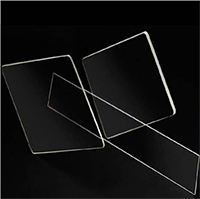
BK7 optical glass wafers are used in research and development where optical transparency, a smooth polished surface, and reliable dimensional control are important. Applications include precision optics, microfabrication, optical coatings, sensors, microscopy, photonics, and experimental microfluidic devices.
UniversityWafer supplies BK7 glass wafers and substrates in a range of dimensions and can support projects requiring custom thicknesses, lapping, and polishing.
Custom BK7 Wafer Thickness and Polishing
Researchers and manufacturers frequently require glass substrates with thicknesses and surface finishes that differ from standard inventory. Lapping and polishing can be used to reduce wafer thickness and improve the surface finish for optical and research applications.
One customer requested 100 mm BK7 wafers with a custom finished thickness:
UniversityWafer, Inc. replied:
UniversityWafer offers double-sided lapping and polishing capabilities for substrate processing. Available equipment includes Speedfam 16B-5 double-sided polishing systems using Suba X polishing pads and zirconium oxide polishing compound.
Double-sided lapping can also be performed using Speedfam 16B-5 equipment with 9 micron fixed-abrasive 3M Trizact pads. An additional Speedfam 12B-6 polisher is available for polishing work.
For this particular request, flatness metrology was not available, so the proposed processing would not include a specified or verified flatness requirement.
Reference #269123 for pricing.
Get Your BK7 Glass Wafer Quote FAST!
BK7 Glass for Precision Optics
BK7-type crown glass is widely used for general-purpose precision optics. Its combination of visible-light transmission, relatively low dispersion, consistent refractive properties, and good polishability makes it suitable for many transmissive optical components.
N-BK7, a widely used modern optical glass in this family, has a refractive index of approximately 1.5168 at 587.6 nm and an Abbe number of approximately 64.17. These properties make it useful in optical designs requiring predictable refraction and relatively low chromatic dispersion.
Common BK7 Optical Applications
- Optical windows and protective windows
- Lenses and lens elements
- Prisms and beam-steering optics
- Microscope and imaging optics
- Camera and projection systems
- Laboratory optical assemblies
- Optical sensors
- Thin-film and coating research
BK7, N-BK7, S-BSL7, and K9 Glass
Researchers may encounter several optical glasses sold for similar applications. However, these materials should not automatically be considered identical. Optical constants, transmission, homogeneity, chemical properties, thermal behavior, and manufacturing tolerances can vary by composition and manufacturer.
N-BK7 Optical Glass
SCHOTT N-BK7 is a well-characterized borosilicate crown optical glass commonly used for lenses, windows, prisms, and other precision optical components. Its documented refractive index and dispersion properties make it useful when optical design calculations require controlled material properties.
Ohara S-BSL7
Ohara S-BSL7 is another optical crown glass used in applications similar to those served by N-BK7. When considering one glass as an alternative to another, researchers should compare the manufacturer's current optical, thermal, chemical, and mechanical specifications rather than assuming the materials are exactly interchangeable.
K9 Optical Glass
K9 is a designation commonly associated with Chinese optical crown glasses. Depending on the manufacturer and grade, K9 materials may be considered for windows, plates, and other general optical applications. Because specifications can vary among suppliers, the material data for the specific K9 product should be reviewed before substituting it for N-BK7 in a precision optical design.
BK7 Glass for Photolithography and Microfabrication
Polished BK7 wafers can be used as transparent substrates for photolithography and experimental microfabrication. Their optical transparency can be particularly useful when a device requires illumination, imaging, or alignment through the substrate.
A BK7 wafer can be coated with photoresist and patterned to produce microstructures or to define subsequently deposited materials. Depending on the process, researchers may deposit metals, dielectric films, transparent conductive layers, or other functional coatings on the glass surface.
Research Applications Include:
- Micro-optical structures
- Patterned metal electrodes
- Optical sensor prototypes
- Thin-film devices
- Microfluidic structures
- Photonics research
- Experimental MEMS structures
Process conditions should be evaluated carefully because BK7 does not have the same thermal, chemical, or mechanical properties as silicon, fused silica, or dedicated photomask materials.
BK7 for Microscopy and Imaging
BK7-type optical glass is used in components found in microscopy and imaging systems, including lenses, windows, prisms, and other transmissive optics. Its relatively low dispersion and predictable refractive properties make it useful for controlling and focusing visible light.
Wafer-format BK7 can also provide a transparent experimental platform for optical research. Researchers may fabricate thin films, patterned structures, electrodes, or sensing layers on the surface while observing the device or sample through the glass.
BK7 Glass in Medical and Biophotonics Research
Optical glasses in the BK7 family can be incorporated into optical components used in biomedical imaging, analytical instrumentation, microscopy, spectroscopy, and biophotonics. Typical uses involve the glass as an optical element or transparent substrate rather than assuming that the material itself is suitable for direct biological contact.
Potential Research Applications
- Biomedical Imaging: Optical windows and lens components for laboratory imaging systems.
- Microscopy: Precision optical components and transparent experimental substrates.
- Spectroscopy: Optical components used to transmit or manipulate light in analytical instruments.
- Optical Biosensors: Transparent substrates for patterned sensing layers, coatings, and optical detection structures.
- Microfluidics: Transparent substrates that allow optical observation of channels, particles, and fluids.
- Biophotonics: Experimental platforms for optical detection, fluorescence, and light-based analytical techniques.
For devices that will contact biological samples or tissue directly, researchers should independently verify the required biocompatibility, surface treatment, sterilization, and regulatory requirements for the finished device.
BK7 for Sensors and Imaging Systems
BK7 can be used for optical windows, lenses, and substrates in sensing and imaging systems operating within wavelengths appropriate for the material. Its optical properties make it useful for applications where visible-light transmission and dimensional stability are important.
- Machine-vision systems
- Optical inspection equipment
- Imaging sensors
- Laser-based measurement systems
- Laboratory instrumentation
- Optical detection systems
For ultraviolet, infrared, high-temperature, or other specialized environments, alternative substrate materials such as fused silica, sapphire, or infrared optical materials may provide more appropriate performance.
Choosing the Right BK7 Wafer
The appropriate BK7 substrate depends on both the optical requirements and the fabrication process. Before requesting a quote, researchers should consider:
- Wafer diameter or custom dimensions
- Required thickness and thickness tolerance
- Single-side or double-side polishing
- Surface finish requirements
- Flatness and parallelism requirements
- Operating wavelength
- Thin-film or coating requirements
- Maximum processing temperature
- Quantity required
Providing these specifications helps determine whether a standard BK7 wafer is suitable or whether additional lapping, polishing, or custom processing is required.
What Is BK7 Optical Glass?
BK7 is a widely used crown optical glass valued for its combination of optical transmission, relatively low dispersion, mechanical stability, and cost-effective optical performance. Modern optical systems commonly use materials such as SCHOTT N-BK7®, which has well-characterized optical properties and is widely used for lenses, windows, prisms, plates, and other precision optical components.
N-BK7 has a refractive index of approximately 1.5168 at 587.6 nm and an Abbe number of approximately 64.17. The relatively high Abbe number indicates comparatively low chromatic dispersion, making the glass useful in optical systems where control of wavelength-dependent refraction is important.
Why Use BK7 Glass Wafers and Substrates?
BK7 wafers provide a transparent, polishable substrate for optical, photonic, sensing, and microfabrication research. Unlike semiconductor wafers such as silicon, BK7 is electrically insulating and transparent across much of the visible spectrum, allowing light to pass through the substrate while structures, coatings, electrodes, or microfeatures are fabricated on its surface.
Properly polished BK7 substrates can provide smooth optical surfaces suitable for thin-film deposition, lithographic patterning, optical coatings, micro-optical structures, and experimental devices. Thickness, surface finish, parallelism, flatness, and dimensional tolerances should be selected according to the requirements of the application.
Optical Properties of BK7 Glass
The optical properties of BK7-type crown glass make it useful for general-purpose precision optics. Important characteristics include:
- High visible transmission: BK7 transmits light efficiently through much of the visible spectrum when properly polished and when surface-reflection losses are taken into account.
- Relatively low dispersion: Its Abbe number of approximately 64 makes BK7 a low-dispersion crown glass commonly used in imaging and optical systems.
- Well-characterized refractive index: N-BK7 has a refractive index of approximately 1.5168 at the helium d-line wavelength of 587.6 nm.
- Good polishability: BK7 can be ground, lapped, and polished to produce smooth surfaces for optical components and research substrates.
- Optical coating compatibility: Polished BK7 surfaces can be coated with dielectric, metallic, antireflection, filter, and other functional thin films.
BK7 Glass Applications
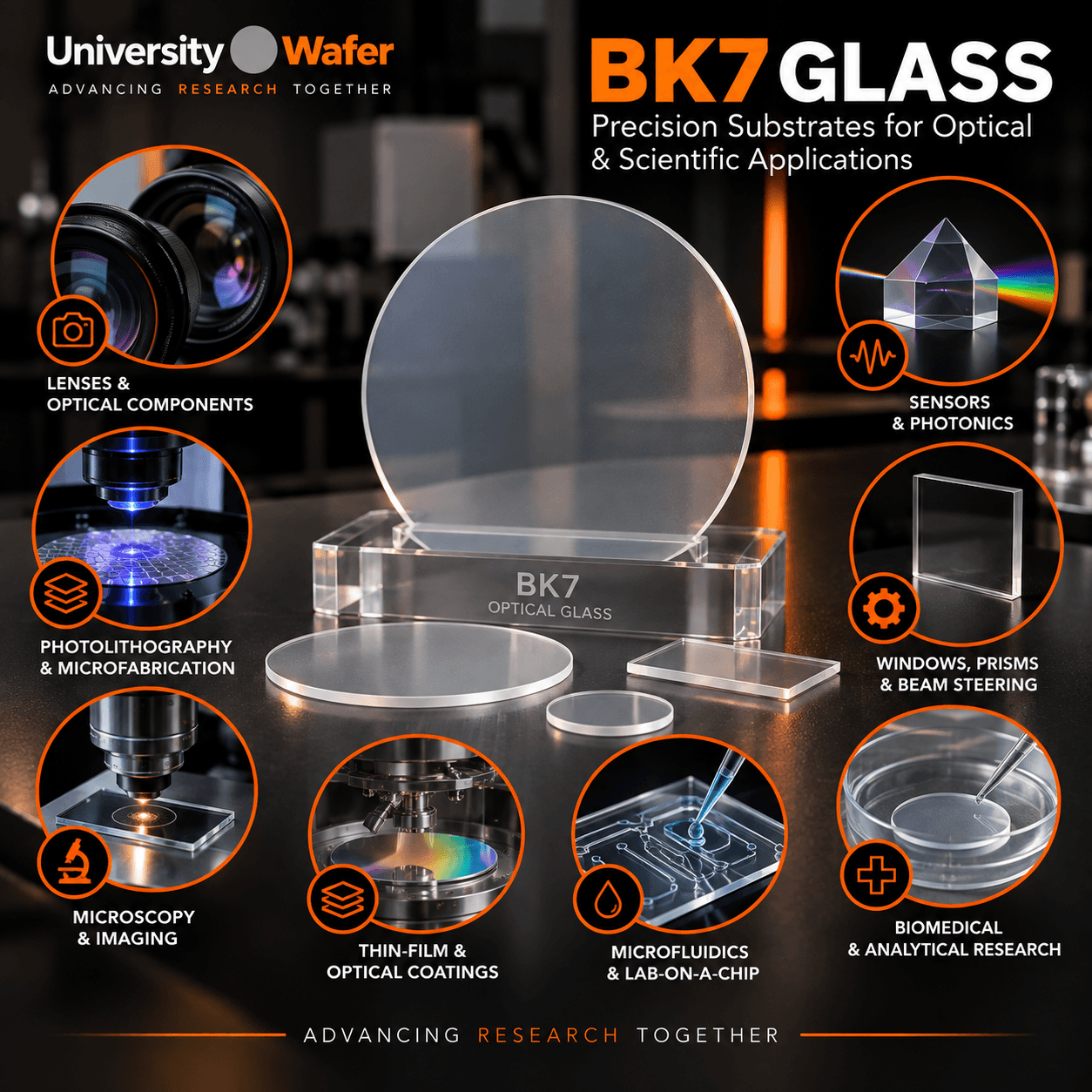
BK7 is used in both conventional optical components and wafer-format research substrates. The exact material grade, surface quality, and dimensional tolerances should be selected according to the optical and fabrication requirements of the project.
Lenses and Precision Optics
One of the most established uses of BK7-type crown glass is the fabrication of optical components. Its combination of refractive index, dispersion, transmission, and manufacturability makes it suitable for many general-purpose optical systems.
- Lenses and lens elements
- Optical windows and protective windows
- Prisms and beam-steering components
- Imaging and microscopy optics
- Laboratory optical assemblies
- Projection and camera optics
Photolithography and Microfabrication
BK7 wafers can serve as transparent substrates for research involving photolithography and microfabrication. A polished glass surface can be coated with photoresist, patterned, metallized, or covered with dielectric and functional thin films.
Applications can include micro-optical structures, patterned electrodes, experimental sensors, microfluidic structures, and other devices where optical access through the substrate is useful. Process compatibility should always be evaluated for the specific chemicals, temperatures, coatings, and dimensional tolerances involved.
Thin-Film and Optical Coating Research
BK7 substrates are useful as carriers for deposited optical and functional films. Researchers can deposit dielectric or metallic layers onto polished BK7 to investigate reflection, transmission, interference, sensing, or other optical behavior.
- Antireflection coatings
- Dielectric multilayer coatings
- Metal thin films
- Optical filters
- Transparent or patterned electrodes
- Experimental photonic structures
Microscopy and Imaging
BK7 is widely associated with optical imaging because it can be formed into precision lenses, windows, and other transmissive components. In research systems, BK7 wafers and plates may also provide transparent platforms for experiments that require illumination or observation through the substrate.
Sensors and Photonics
The optical transparency and processable surface of BK7 make it useful for prototype optical sensors and photonic experiments. Thin films, patterned metals, sensing layers, or microstructures can be fabricated on the glass while allowing optical interrogation through the substrate.
Microfluidics and Lab-on-a-Chip Research
Glass substrates are commonly used in microfluidic research because transparent substrates permit direct optical observation of channels, fluids, particles, and biological samples. BK7 may be selected when optical performance is important, although the suitability of a particular glass should be evaluated against the required fabrication, bonding, chemical, and thermal processes.
BK7 vs. Fused Silica
BK7 and fused silica are both transparent substrate materials, but they are not interchangeable in every application. BK7 is a versatile optical crown glass that provides good visible optical performance at a comparatively practical cost. Fused silica is often selected when an application requires stronger ultraviolet transmission, lower thermal expansion, or operation under more demanding thermal conditions.
The best substrate therefore depends on wavelength range, thermal requirements, surface specifications, fabrication process, and budget.
Choosing a BK7 Glass Wafer
When specifying BK7 wafers for research or production, consider the properties that directly affect the final device or experiment:
- Diameter or lateral dimensions
- Wafer thickness and thickness tolerance
- Surface finish and polishing requirements
- Flatness and parallelism requirements
- Optical wavelength range
- Surface coatings or deposited films
- Thermal and chemical processing conditions
- Quantity required for research or production
UniversityWafer can supply BK7 glass substrates for research and production applications and can help evaluate wafer dimensions, thickness, polishing, and other substrate requirements.