
Metal-Oxide Semiconductor Field Effect Transistor (MOSFET) Preparation
Researchers fabricating MOSFETs (Metal-Oxide-Semiconductor Field-Effect Transistors) require high-quality silicon substrates with controlled oxide thickness and excellent surface quality. Prime grade silicon wafers with thermal oxide are commonly used for transistor fabrication, gate dielectric studies, photolithography, and semiconductor device development.
One popular substrate for MOSFET preparation is:
This wafer specification is suitable for semiconductor research involving gate oxide formation, transistor characterization, dielectric studies, MEMS fabrication, and microelectronic device development. Custom diameters, resistivities, orientations, and oxide thicknesses are also available.
Common MOSFET Research Applications
- CMOS and MOSFET fabrication
- Gate oxide characterization
- Photolithography and thin-film deposition
- MEMS device development
- Electrical and semiconductor device testing
- Microelectronics and integrated circuit research
Need a different wafer specification? Please send your diameter, orientation, dopant type, resistivity, thickness, oxide thickness, and quantity requirements for a fast quotation.
Get Your MOSFET Wafer Quote FAST!
Video Explains How MOSFETs Work
Learn the fundamentals of MOSFET operation, gate control, source and drain behavior, and how field-effect transistors are used in modern semiconductor devices.
What Is a MOSFET?
A MOSFET, or Metal-Oxide-Semiconductor Field-Effect Transistor, is a semiconductor device used to control current flow in electronic circuits. MOSFETs are widely used in integrated circuits, power electronics, sensors, amplifiers, switching devices, and research-scale semiconductor fabrication.
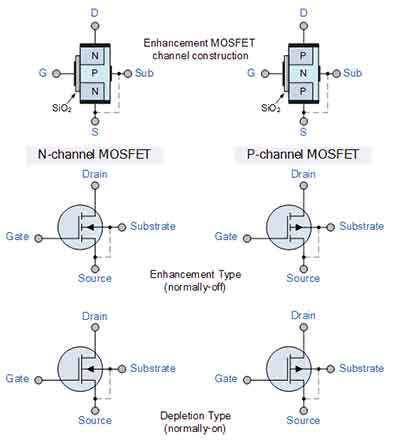
In a basic MOSFET structure, current flows between the source and drain terminals. The gate controls this current by using an electric field. A thin insulating oxide layer, often silicon dioxide, separates the gate from the semiconductor channel. This gate oxide is why thermal oxide silicon wafers are commonly used for MOSFET preparation and device research.
How Does a MOSFET Work?
A MOSFET works by changing the conductivity of a channel near the surface of a semiconductor wafer. When voltage is applied to the gate, it creates an electric field that attracts or repels charge carriers. This process forms or removes a conductive path between the source and drain.
Researchers often use P-type silicon wafers or N-type silicon wafers depending on the device design. The wafer type, resistivity, crystal orientation, oxide thickness, and surface polish all affect MOSFET performance.
Why Thermal Oxide Wafers Are Used for MOSFET Preparation
Thermal oxide on silicon provides a high-quality insulating layer for MOSFET gate structures. A controlled oxide thickness helps researchers study gate behavior, leakage current, threshold voltage, and semiconductor interface quality. For many university and laboratory projects, silicon wafers with thermal oxide are a practical starting substrate for MOSFET fabrication.
Common MOSFET preparation wafers may include prime grade silicon, low-resistivity silicon, single-side polished surfaces, and oxide layers such as 90nm, 100nm, 300nm, or custom thermal oxide thicknesses. UniversityWafer, Inc. can quote stock and custom specifications for MOSFET research.
Common MOSFET Research Applications
MOSFET substrates are used in transistor fabrication, semiconductor device testing, gate oxide studies, thin film deposition, photolithography, doping experiments, and electrical characterization. Researchers may also use MOSFET test structures to evaluate dielectric materials, contact metals, channel mobility, and wafer surface quality.
Whether your project requires silicon wafers, thermal oxide, low-resistivity substrates, or custom-doped material, the correct wafer specification is important for reliable MOSFET preparation.
Order MOSFET Preparation Wafers
UniversityWafer, Inc. supplies silicon and thermal oxide wafers for MOSFET preparation, field-effect transistor research, and semiconductor device fabrication. Please send your required diameter, orientation, dopant type, resistivity, thickness, polish, oxide thickness, and quantity for a fast quote.