
"I want to buy some [100] 1-inch diameter silicon wafers . The thickness should be less than 500 µm. The surface should be flat, and the resistance should be as low as possible because I will use the wafers for lithium-silicon battery research."
Low-Resistivity Silicon Wafers for Lithium-Ion Battery Research
Silicon wafers are used in lithium-ion battery research to develop and study silicon-based anodes, thin films, nanostructures, and advanced electrode materials. Low-resistivity silicon can be especially useful when electrical conductivity through the substrate is important to the experiment.
Researcher Silicon Wafer Request
A PhD candidate requested the following silicon wafer specifications for lithium-silicon battery research:
Reference #276988 for specifications and pricing.
Get Your Silicon Wafer Quote FAST! Or, Buy Online and Start Researching Today!
Silicon Wafers Used in Lithium-Ion Battery Research
Researchers have used a variety of silicon wafers to fabricate and characterize electrodes for lithium-ion battery experiments. The appropriate wafer depends on the electrical, mechanical, and surface requirements of the research.
Example Silicon Wafer Specifications
- Si Item #809: 100mm, N-type, phosphorus-doped, <100>, 1–10 Ω-cm, 500 µm, SSP, Prime Grade
- Si Item #2167: 100mm, N-type, phosphorus-doped, <100>, 0.001–0.005 Ω-cm, 500 µm, SSP, Test Grade
- Si Item #3599: 200mm, P-type, boron-doped, <100>, 1–10 Ω-cm, 725 µm, SSP, Test Grade, with 100nm wet thermal oxide
These specifications are examples from previous research requirements. Battery experiments may require different resistivity, orientation, thickness, surface finish, or oxide thickness depending on the fabrication process.
What Materials Are Used in Lithium-Ion Batteries?
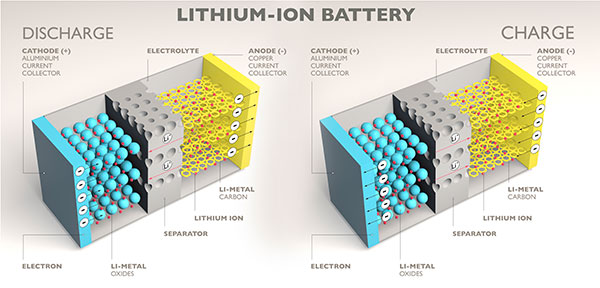
A lithium-ion battery contains several functional components, including an anode, cathode, electrolyte, separator, and current collectors. In research environments, silicon wafers and other substrates may also be used to fabricate or characterize experimental electrode structures.
1. Anode Materials
The anode stores lithium during charging. Graphite remains a common anode material, while silicon is extensively investigated for next-generation lithium-ion battery electrodes.
- Graphite: A widely used lithium-ion battery anode material.
- Silicon: Studied because of its high lithium-storage capacity and potential for higher-capacity battery electrodes.
- Silicon-carbon composites: Combine silicon with carbon-based materials to improve electrical and mechanical properties.
- Nanostructured silicon: Silicon nanowires, nanoparticles, porous silicon, and related structures are investigated to help manage the mechanical stresses associated with repeated charging and discharging.
2. Cathode Materials
The cathode is the positive electrode of a lithium-ion cell. Different lithium-containing materials are selected according to the desired energy, power, lifetime, safety, and application requirements.
- Lithium Cobalt Oxide (LiCoO2)
- Lithium Iron Phosphate (LiFePO4)
- Lithium Manganese Oxide (LiMn2O4)
- Nickel Manganese Cobalt Oxide (NMC)
Cathode active materials are commonly coated onto aluminum foil, which functions as the cathode current collector.
3. Electrolytes
The electrolyte transports lithium ions between the positive and negative electrodes. Lithium-ion battery research includes both conventional liquid electrolytes and solid-state electrolyte systems.
- Liquid electrolytes: Typically contain a lithium salt dissolved in suitable organic solvents.
- Solid electrolytes: May use ceramic, sulfide, polymer, or other solid ion-conducting materials.
4. Separators
The separator electrically isolates the anode and cathode while allowing lithium ions to move through the electrolyte between the electrodes.
- Polyethylene (PE)
- Polypropylene (PP)
- Ceramic-coated separator films
Substrates Used in Battery Research Laboratories
Battery researchers may use semiconductor and optical substrates when developing thin-film electrodes, nanostructures, coatings, and experimental energy-storage materials.
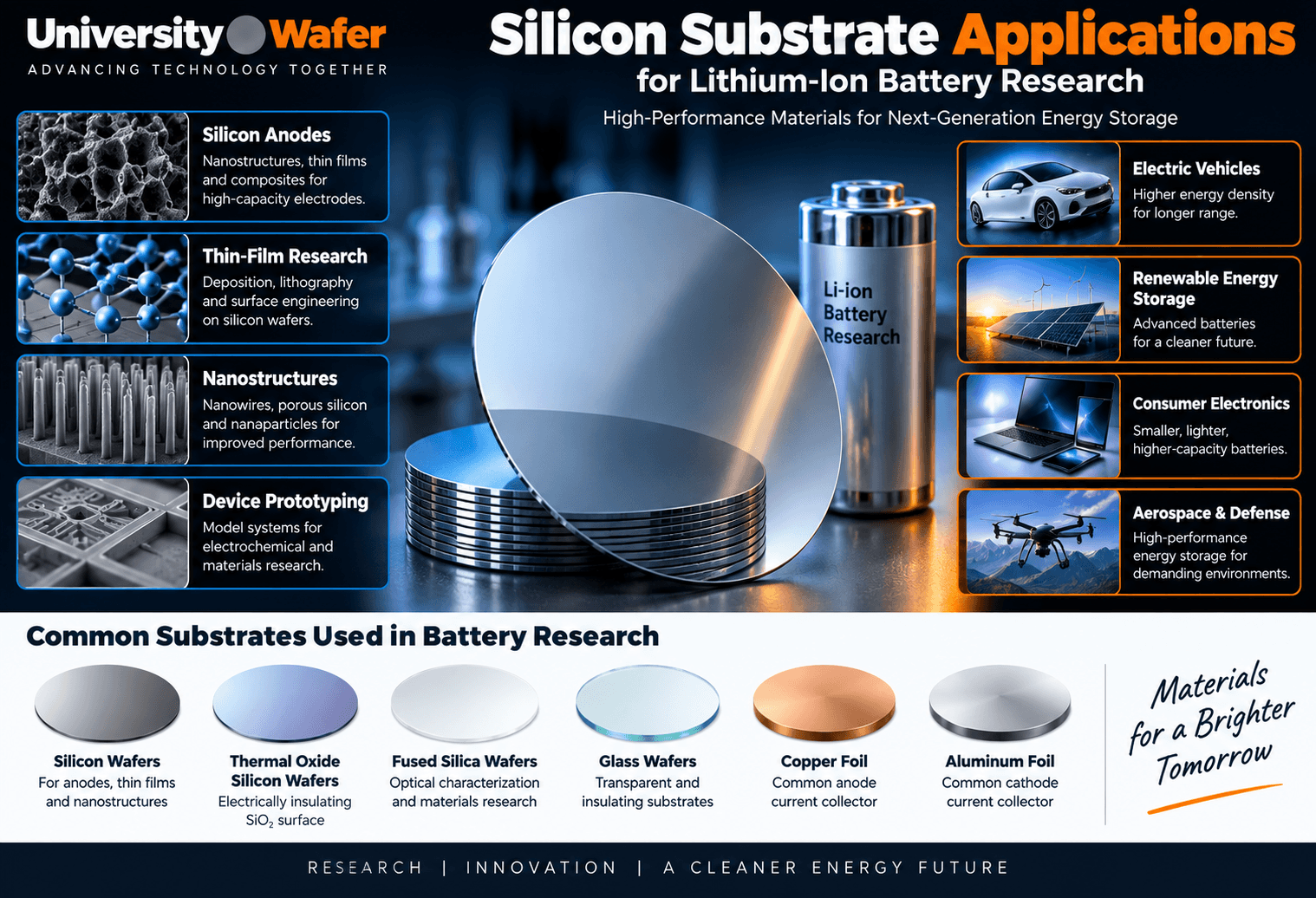
- Silicon Wafers — used for silicon-based anodes, thin films, surface studies, and nanostructure fabrication.
- Thermal Oxide Silicon Wafers — useful when an electrically insulating SiO2 surface is required.
- Fused Silica Wafers — transparent substrates useful for optical characterization and materials research.
- Glass Wafers — used as transparent and electrically insulating research substrates.
Silicon Nanostructures for Battery Research
Researchers continue to investigate silicon nanostructures such as nanowires, porous silicon, nanoparticles, and patterned thin films. These structures provide different approaches for studying lithium transport, electrode degradation, surface reactions, and mechanical expansion during battery cycling.
Need silicon wafers for lithium-ion battery research? Provide your required diameter, thickness, orientation, dopant, resistivity, polish, coating, and quantity when requesting a quote.
Silicon Wafers for Lithium-Ion Battery Research
Silicon is widely studied as an advanced anode material for lithium-ion batteries because it can store substantially more lithium than conventional graphite. Researchers use silicon wafers as controlled substrates for developing and characterizing silicon-based electrodes, thin films, nanostructures, and other experimental battery materials.
UniversityWafer supplies silicon substrates with different diameters, thicknesses, crystal orientations, dopant types, resistivities, and surface finishes for battery research and materials development.
Why Is Silicon Used in Lithium-Ion Battery Anodes?
Conventional lithium-ion batteries commonly use graphite as the active material in the negative electrode. Silicon is attractive because of its high theoretical lithium-storage capacity, making it an important material for research into higher-capacity battery anodes.
Silicon can be investigated in several forms, including crystalline silicon, silicon nanoparticles, porous silicon, silicon nanowires, thin films, silicon oxides, and silicon-carbon composites. Silicon wafers provide a flat and well-characterized starting surface for studying many of these structures.
The Challenge of Silicon Volume Expansion
One of the major challenges with silicon anodes is the large volume change that occurs as silicon alloys with lithium during charging and then contracts during discharge. Repeated expansion and contraction can damage the active material, disrupt electrical contact, and contribute to capacity loss over repeated cycles.
Researchers therefore investigate nanostructured silicon, porous structures, composite electrodes, specialized binders, protective coatings, and other approaches designed to accommodate mechanical stress while maintaining electrical performance.
Silicon Wafer Properties for Battery Research
The appropriate silicon wafer depends on the experiment. Important specifications may include wafer diameter, thickness, conductivity type, dopant, resistivity, crystal orientation, surface finish, and the presence of an oxide or other deposited layer.
- Conductivity Type: P-type or N-type silicon
- Crystal Orientation: Common options include <100> and <111>
- Resistivity: Low-resistivity through high-resistivity material
- Surface Finish: Single-side polished (SSP) or double-side polished (DSP)
- Diameter: Small research wafers through standard semiconductor wafer sizes
- Surface Layers: Bare silicon, thermal oxide, and other processed surfaces
Low-Resistivity Silicon Wafers
Low-resistivity silicon can be useful when electrical conductivity through the substrate is important to the experimental design. UniversityWafer offers heavily doped silicon wafers as well as higher-resistivity material, allowing researchers to select substrates based on their electrical and processing requirements.
The page includes examples of silicon wafers previously requested for lithium-ion battery research, including low-resistivity N-type material and silicon wafers with thermal oxide. These examples can help researchers identify specifications to consider when requesting material for a new experiment.
Silicon Thin-Film Anode Research
Silicon wafers are particularly useful for thin-film battery research because their smooth surfaces are compatible with deposition, lithography, etching, and materials characterization. Researchers can deposit silicon or other electrode materials onto a controlled substrate and evaluate properties such as film thickness, morphology, adhesion, electrical behavior, and cycling performance.
Thin-film structures can also help researchers investigate how silicon responds to lithiation and delithiation under controlled experimental conditions.
Nanostructured Silicon for Battery Anodes
Nanostructured silicon is another major area of battery research. Silicon nanowires, porous silicon, nanoparticles, and other nanoscale structures are studied as possible ways to accommodate the mechanical stresses associated with repeated lithium insertion and extraction.
Silicon substrates can serve as starting surfaces for fabricating or characterizing these structures using semiconductor and materials-science processing techniques.
Silicon-Carbon Composite Anodes
Another research approach combines silicon with carbon-based materials. The objective is to take advantage of silicon's high lithium-storage capacity while using carbon structures to help maintain electrical conductivity and mechanical stability.
Silicon-carbon systems are investigated in many forms, including particles, coatings, porous structures, and composite electrodes. The optimum structure depends on the fabrication process and the intended battery design.
Other Substrates Used in Battery Research
Silicon is not the only substrate used in battery laboratories. Researchers may select different materials depending on whether they are studying electrochemistry, thin films, optical behavior, surface morphology, or device fabrication.
- Silicon wafers — controlled surfaces for silicon anodes, nanostructures, and thin-film experiments
- Thermal oxide silicon wafers — useful when an electrically insulating SiO2 layer is required
- Glass and fused silica — useful for experiments requiring transparent substrates
- Metal current collectors — commonly used as conductive supports for electrode materials
Applications of Silicon Battery Research
Research into silicon-based lithium-ion battery materials supports the development of energy-storage technologies for electric vehicles, portable electronics, aerospace systems, grid storage, and other applications where higher energy density and improved battery performance are important.
Silicon wafer experiments can also support fundamental research into electrochemistry, surface reactions, material degradation, thin-film behavior, and nanoscale electrode structures.
Choosing Silicon Wafers for Battery Research
When requesting silicon wafers for lithium-ion battery research, provide as much information as possible about the required diameter, thickness, crystal orientation, conductivity type, dopant, resistivity, surface finish, coating, and quantity. These specifications help identify a substrate that is appropriate for the intended fabrication or characterization process.