
I am using silicon wafers for the fabrication of single electron transistors and quantum tunneling transport devices.
Silicon Wafers for Single Electron Transistor Fabrication
Single Electron Transistors (SETs) are among the most promising devices in nanoelectronics and quantum computing. These devices exploit quantum tunneling transport and Coulomb blockade effects to control the flow of individual electrons. High-quality silicon wafers with thermal oxide are commonly used as substrates for SET fabrication because they provide excellent electrical isolation, low defect densities, and compatibility with nanofabrication processes.
Researcher's Request for Quantum Tunneling Devices
A researcher developing single electron transistors requested silicon substrates for quantum tunneling transport experiments.
UniversityWafer Solution
The following substrate was recommended for SET fabrication:
- Item #23630
- 76.2 mm diameter silicon wafer
- P-type (100) orientation
- Resistivity: 1–10 Ω-cm
- Single-side polished (SSP)
- 380 µm thickness
- 1 µm thermal oxide layer
The thermal oxide provides excellent electrical insulation and serves as a dielectric layer for nanoscale device fabrication.
Reference specifications are available upon request.
Why Thermal Oxide Silicon Wafers Are Used for SET Devices
Silicon wafers with thermally grown SiO2 layers are widely used in quantum electronics because they offer:
- Low interface defect densities
- Excellent electrical insulation
- Compatibility with electron beam lithography
- High-quality tunnel junction fabrication
- Stable dielectric properties
- Compatibility with CMOS and MEMS processing
Applications of Single Electron Transistors
- Quantum computing
- Quantum dots
- Nanoelectronics
- Cryogenic electronics
- Ultra-low-power circuits
- Single-photon detectors
- Charge sensors
- Quantum information processing
- Single-molecule electronics
Get Your Silicon Wafer Quote FAST!
Need silicon wafers for single electron transistor fabrication or quantum device research?
Get Your Quote FAST! Or, Buy Online and start researching today.
What Is a Single Electron Transistor (SET)?
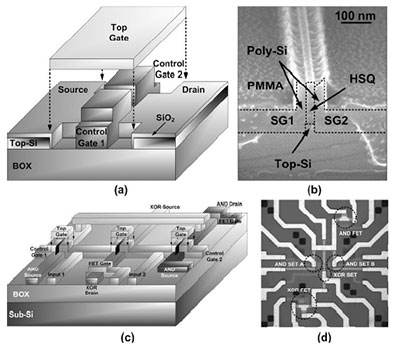 A Single Electron Transistor (SET) is an ultra-sensitive nanoelectronic device that controls the movement of individual electrons through a quantum dot using the phenomenon of quantum tunneling. SETs are among the smallest transistor structures ever developed and are widely studied for applications in quantum computing, nanoscale sensors, ultra-low-power electronics, and single-photon detection.
How Does a Single Electron Transistor Work?
Single electron transistors contain a small conducting island, often referred to as a quantum dot, connected to source and drain electrodes by tunnel junctions. The flow of electrons is controlled by a gate electrode that modulates the electric field surrounding the island.
Because electrons tunnel one at a time, SET devices exhibit extremely high sensitivity and very low power consumption. This behavior makes them attractive for next-generation nanoelectronics and quantum technologies.
Components of a Single Electron Transistor
- Source electrode
- Drain electrode
- Tunnel junctions
- Quantum dot (island)
- Gate electrode
- Dielectric layers and insulating oxides
- Silicon substrate or SOI wafer
Why Silicon Wafers Are Used for SET Fabrication
Silicon wafers remain one of the most popular substrates for single electron transistor fabrication because they offer excellent compatibility with semiconductor processing technologies and nanofabrication techniques.
- Excellent electrical properties
- Compatibility with CMOS fabrication
- Low defect densities
- High-quality thermal oxide layers
- Compatibility with electron beam lithography
- Suitable for quantum dot fabrication
Quantum Tunneling and Coulomb Blockade
The operation of a single electron transistor depends on two important quantum mechanical effects:
- Quantum Tunneling: Electrons pass through insulating barriers that would normally block current flow.
- Coulomb Blockade: Electron transport occurs one electron at a time, allowing precise control over electrical current.
These effects enable SET devices to detect extremely small charges and currents that conventional transistors cannot measure.
Applications of Single Electron Transistors
- Quantum computing
- Quantum dots and quantum electronics
- Nanoelectronics research
- Ultra-sensitive charge detectors
- Single-photon detectors
- Single-molecule electronics
- Medical and biosensing devices
- Low-power integrated circuits
- Cryogenic electronics
Single Electron Transistors vs Conventional MOSFETs
| Feature | Single Electron Transistor | MOSFET |
|---|---|---|
| Charge Transport | Single electrons | Many electrons |
| Operating Principle | Quantum tunneling | Field effect |
| Power Consumption | Extremely low | Low |
| Sensitivity | Very high | Moderate |
| Applications | Quantum devices | Integrated circuits |
Materials Used for Single Electron Transistor Research
Researchers fabricate SET devices using a variety of materials including:
- Silicon wafers
- SOI wafers
- Silicon with thermal oxide
- Gallium arsenide (GaAs)
- Graphene substrates
- Silicon germanium (SiGe)
- III-V semiconductor materials
The Future of Single Electron Electronics
Single electron transistors are expected to play an important role in future quantum technologies, ultra-low-power processors, nanoscale memory devices, and advanced sensors. As device dimensions continue to shrink, SETs represent one of the most promising approaches for extending semiconductor technology beyond conventional CMOS scaling.