A PhD candidate studying materials engineering requested the following quote.
Do you have amorphous p-doped Si wafers, or amorphous p-doped thin films deposited on wafers? What are the prices and lead times, because we would also need
carrier concentrations.
We need a carrier concentration of 1015/cm3. We need the material to be fully amorphous, and we do not need it to be a wafer. A 10µm film deposited on a substrate like glass or fused quartz is OK too – we just need the film to 100% amorphous. We need around a 2inch wafer, and we need highly uniform carrier concentrations, preferably with Hall/van der Pauw measurements confirming the values.
The substrate can definitely be fused quartz, but the film on top of it must at least be a 10µm thick coating of p-type doped amorphous silicon.
Reference #213346 for specs and pricing.
A staff scientist requested a quote for the following.
I see your sites have ZnSe and GaP wafers. I am not using them for THz applications. I am looking for thin, highly electrical resistive (undoped or semi-insulating), double side polished. Your site has some resistivity info on GaP, however, I cannot find any electrical parameters on ZnTe (mostly looking for resistivity). Could you provide price estimates and lead time info?
Question:
About general resistivity of the following wafer spec, how are they normally measured with these wafers? With probes on certain point of the wafer? (what kind of probes?) Or with electrical coatings on both sides?
Item Qty. Description
IM18. 1/2/4 2 are Prime Grade, 1 with a scratch on the back, 1 with a scratch on the top Gallium Phosphide wafers, Prime Grade, P/E 2"Ø×370±20µm, SI GaP:Cr[100], Ro=2E10 Ohmcm,
Nc=4.1E06/cc, u=75cm²/Vs, EPD<5E4/cm², One-side-polished, back-side matte etched, SEMI Flats, Sealed under nitrogen in single wafer cassette.
Answer:
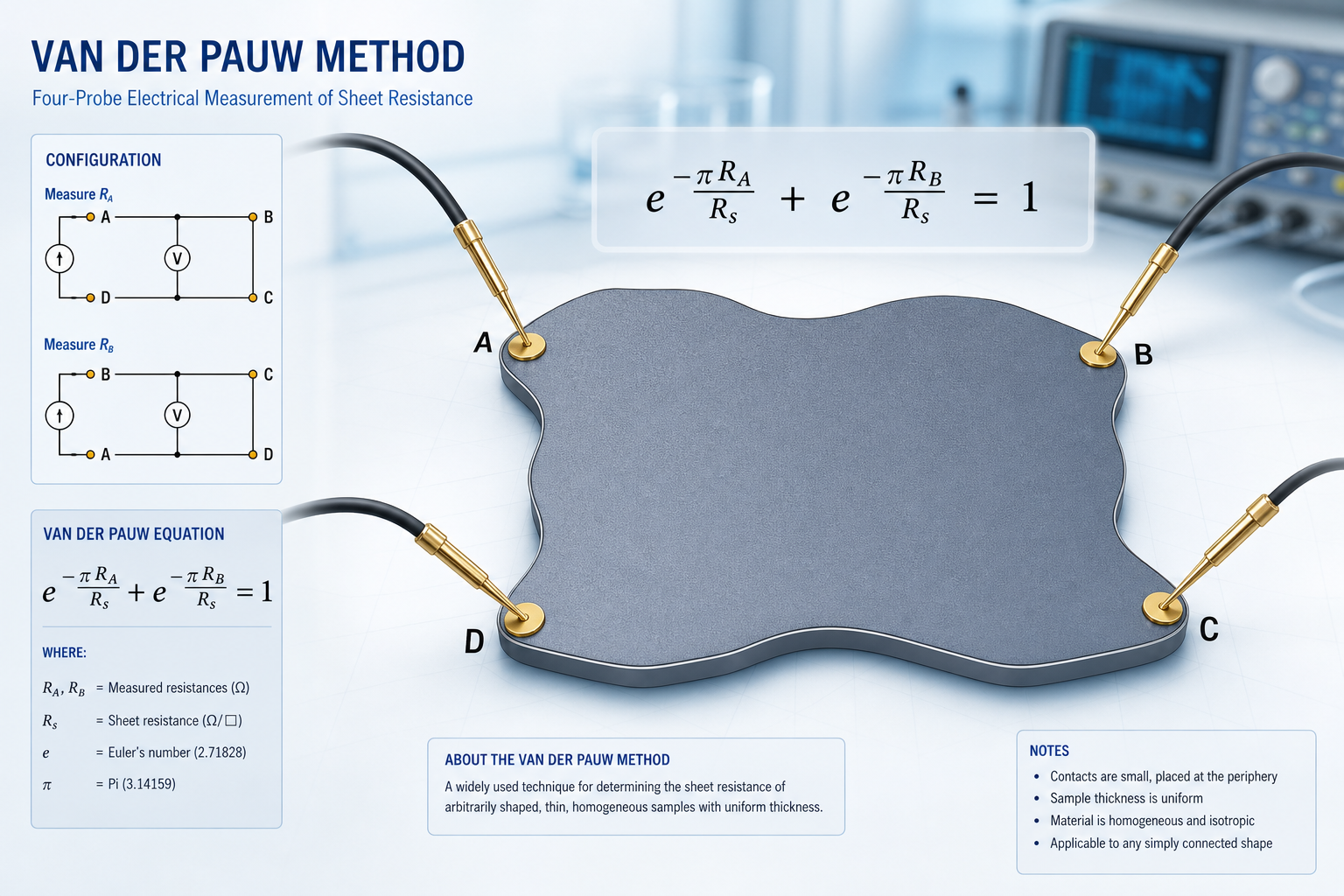
The resistivity is measured on square shaped witness wafers with the 4-point Van der Pauw method.
Reference #317823 for specs and pricing.