
I am looking to purchase a couple of Ø50~80mm × 1mm thick silicon wafers with NIST traceable flatness specifications to use as standards in the validation of our Tropel interferometry tool. I would like each sample to have two different warp values.
NIST Traceable Flatness Standards for Semiconductor Metrology
Semiconductor manufacturers and metrology laboratories use NIST traceable silicon wafer standards to validate interferometry systems, characterize wafer warp and bow, and maintain measurement accuracy. Certified flatness standards provide repeatable results for process control, equipment calibration, and quality assurance.
A production manager at a semiconductor company requested the following quote:
Reference #320997 for specifications and pricing.
Applications of NIST Traceable Silicon Wafer Standards
NIST traceable standards are widely used throughout semiconductor manufacturing and research environments where precision measurements are critical. Typical applications include:
- Interferometer calibration and validation
- Wafer warp and bow measurements
- Semiconductor metrology and process control
- Film thickness measurements
- Photolithography process development
- MEMS fabrication
- Failure analysis and quality assurance
- Research and development laboratories
- Advanced packaging and device characterization
Get Your NIST Traceable Standard Quote FAST!
UniversityWafer supplies custom silicon standards for interferometry, warp measurements, flatness characterization, and semiconductor metrology applications. Standards are available in multiple diameters, thicknesses, orientations, and certified specifications.
Need custom warp values or special flatness requirements? Contact us today or Buy Online and start researching today!
What is NIST Traceability in Semiconductor Manufacturing?
NIST traceability refers to an unbroken chain of calibrations and measurements that link semiconductor manufacturing processes back to standards established by the National Institute of Standards and Technology (NIST). 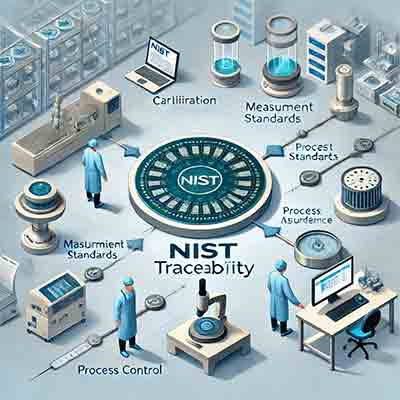 NIST traceable standards are essential for semiconductor metrology, process control, equipment calibration, and quality assurance because they ensure that measurements are accurate, repeatable, and internationally recognized.
Advanced semiconductor manufacturing depends on extremely precise measurements of wafer flatness, thickness, bow, warp, film thickness, and electrical properties. NIST traceability helps manufacturers maintain consistency and maximize device yield.
Why NIST Traceability is Important for Semiconductor Metrology
Semiconductor fabrication requires nanometer-scale precision. Calibration standards that are traceable to NIST provide confidence that measurements performed today are consistent with measurements performed months or years later and across different manufacturing sites.
NIST traceability is commonly used for:
- Wafer flatness measurements
- Warp and bow characterization
- Thickness measurements
- Interferometry tool validation
- Film thickness calibration
- Lithography process control
- Electrical measurements and device characterization
- Quality assurance and failure analysis
Calibration Standards for Semiconductor Equipment
Processes such as photolithography, etching, deposition, and metrology depend on highly accurate instruments. Equipment including interferometers, profilometers, ellipsometers, and thickness measurement systems require regular calibration using standards that are traceable to NIST.
Accurate calibration reduces process variation and helps maintain repeatable semiconductor manufacturing processes.
NIST Traceable Silicon Wafer Standards
NIST traceable silicon wafers are often used as reference standards for measuring wafer warp, bow, flatness, and total thickness variation (TTV). These standards are valuable for validating interferometry systems and maintaining measurement consistency in semiconductor production environments.
Researchers and manufacturers may require wafers with multiple certified warp values, specific diameters, or custom thicknesses to support equipment calibration and process development.
Applications of NIST Traceability
- Semiconductor metrology
- Interferometer calibration
- Process control and yield improvement
- Research and development
- Quality assurance programs
- MEMS fabrication
- Wafer thickness measurements
- Tropel interferometry validation
- Thin-film characterization
- Semiconductor manufacturing certification
Benefits of NIST Traceable Standards
NIST traceable standards improve measurement accuracy, increase reproducibility, reduce manufacturing variability, and provide confidence in semiconductor process control. By maintaining traceability to recognized standards, semiconductor manufacturers can produce devices with tighter tolerances and higher yields while meeting customer and regulatory requirements.